



OFF THE SHELF: JUNE 2026
OFF THE SHELF: APRIL 2026


Cynefin: Wisdom from a Thousand years of Welsh Nature Poetry by Carwyn Graves (Calon, 16 April 2026)
This is a powerful, intelligent book that reconnects us to nature by revisiting the struggle of working with the land over a millennium, the chosen landscape and language Welsh, but the book in English, the poems dual language. It begins and ends with this fabulous stanza of poetry written in an ancient strict-metre Welsh to celebrate the foreshortened life of a North Wales hedge layer called Cledwyn:
In the thorns’ growth his skill – blossoms white/ Into song as it remembers him,/ And woven the hazel rods still,/ Under his smile here spreading (Myrddin ap Dafydd, May 1990)
To anyone who cheers at the sight of the white earliness of blackthorn blossom, or knows the art of hedge laying, this is lovely. But it’s also the point of departure for a thematic guided tour of Welsh nature poetry, taking us towards the struggle of subsistence, working the land, the intimate acquaintance of knowing a place and community and constraint. Wales is good at all that; it’s a vector here for unwinding the grasping, too-developed version of individualism that the author (Worcester, 2011) argues has become commonplace. Are we just going to scroll Instagram for a filtered image of the Milky Way, or are we actually going to get the soil under our fingernails? We are nature, rather than separate from nature, he reminds us. The word of the title, 'Cynefin', can be rendered as ‘haunt’ or ‘abode’, ‘habitat’, or a tract of open mountain land on which sheep have settled. Graves addresses the suspicion that this leads to pastoral idyll or dubious, blood-of-the-land politics. We've been there before but that’s not at all where this book goes. It’s rather a marvellous, critical introduction to Welsh nature poetry that for many obvious reasons ends up deep in the landscape and hard realities of hill farming. Living is courage; mortality is the starting point and lambs are often lost in late-Spring snow drifts. The beauty and love is mixed up in death and loss. They are part of each other. The reader communes with a succession of poets such as TH Parry-Williams, Gwerful and John Dyer, Eiluned Lewis and Nesta Wyn Jones; Dic Jones and RS Thomas. Strangely, the book touches on something currently in the air, noting that the fluent Welsh-speaking former Archbishop of Canterbury Rowan Williams has just penned a book called Solidarity. Possibly, Carwyn has chosen the more original way of approaching this subject, and nowhere does he bludgeon the poetry towards an agenda. Rather, he reveals a concern for the natural environment through good criticism, to win us over.

Novel Crime Scenes: Twenty Deadly Landscapes by Christina Hardyment (Bodleian Library Publishing, April 2026)
The first editor of Oxford Today (from 1988) is also an accomplished literary geographer, never happier than when racing around the countryside tracing plot lines to their settings while respecting the fact that reality often collides with imagination, the plot taking over. Here we have 20 different crime novelists, each treated in a crisp, generous, insightful chapter, never too long. We start with an absolute banger: Arthur Conan Doyle’s The Hound of the Baskervilles (1902). A wise choice because of that ‘desolate, lifeless moor’, the Baskerville Estate mapped here most usefully; also because, as Hardyment informs us, the book was unique among Doyle’s stories because ‘the brooding menace of its setting is much more memorable than Sherlock’s deductions’. The rest of the book goes high and low all over Britain, from Cape Wrath to Dorset and not forgetting city grime, ending on the Brick Lane of Ajay Chowdhury’s The Waiter (2021). Novel Crime Scenes can be read almost as an alternative travel guide to our strange island, the author having travelled herself to so many of these intricate crime plot settings. It is also a broad revisiting of a century ago, the peak of detective fiction reached in 1930, we are told. In other regards still we encounter numerous Oxford luminaries such as the Catholic Ronald Knox (1888-1957), but arguably the best bits for every reader will be the numerous writers and novels they have never heard of – for this reviewer ECR Lorac (Edith Rivett, 1894-1958) who penned over 70 novels but left behind almost nothing about herself, part of a sustained strategy to be taken seriously rather than dismissed on account of her gender; so also Gwen Moffat (1924-) and her literary creation Miss Pink, she of owlish green spectacles and Rolexes. Hardyment generously celebrates the biographies of these remarkable women, and we learn so much in so few words. Otherwise, a gamut of crazy stuff and masterpiece stuff – from hard-boiled Americana dropped on druid-mafia Aberystwyth (Malcolm Pryce) to more mainstream names such as Dorothy L Sayers, PD James and Agatha Christie. Read one chapter a day for 20 days and then order the novels themselves and plan your next knapsack excursion.

Great Literary Sisters by Janet Phillips (Bodleian Library Publishing, April 2026)
Sisterly relationships feature prominently in some of our best-loved classic literature. From Jane and Elizabeth Bennet in Pride and Prejudice to Hasina and Nazneen in Brick Lane, they have provided inspiration for novelists over the centuries. Sisters, explains the author, can be best friends, mother figures, rivals, heroes, sounding boards or partners in crime, depending on literary genre, era, or the demands of plot. They can bring into focus the changing roles of women in society, especially in literature that pre-dates the twentieth century, such as Middlemarch, The Woman in White and The Old Wives’ Tale. Their bonds with younger or older siblings, like those of Meg, Jo, Beth and Amy in Little Women, are often complex and nuanced, and occasionally devastating.
Covering childhood, adventure, affairs of the heart and mental health, this book explores the role of sisters in 20 individual entries, each one providing a synopsis and analysis of the work in question. Including writers as diverse as Charles Dickens, EM Forster, JD Salinger, Toni Morrison and Chimamanda Ngozi Adichie, it makes the perfect read for book-loving sisters, whatever their connection.

Tales from the Common Room: Confessions of an Oxford Don by Horace Hare (Port Meadow Press, 2025)
This is a sophisticated and witty life of an imagined Oxford history don, not of course written by Horace Hare (presumably a play on the actual hare of same name that roamed around the house of a Dublin zookeeper in the 1950s). However, the publisher behind Port Meadow Press, also the inspiration and graft behind the very popular and resolutely non-commercial blog Morris Oxford, does say: ‘It’s a fictional composite, Richard – or so I am led to believe. I didn't write it (honest!). I merely published it on behalf of the pseudonymous author…’
The subterfuge is not because this is a thinly disguised ad hominem attack on a real person or its opposite, hero worship, but a simple matter of securing literary freedom. The imagined don in question writes about himself in the third person, we are told early on, partly because he was insecure having never quite believed in his own gratifying ascent into the top tier of intellectual limelight, after writing a cultural history of the chandelier, thus enlightening the Enlightenment, followed by an unchallenged ‘masterpiece’ about French philosophe Voltaire. That plot device is comedic and conceivably characteristic of a don born in 1938 and imagined as dying in 2020 from COVID – certainly there’s a splash of Lucky Jim here. Plus, Horace regularly dispenses whisky, partly on account of his ‘tortured soul with a dark secret’ at a college called St Jocasta’s. Published to mark the 666th anniversary of the foundation of St Jocasta's, introduced by a certain Moreton Pinkney, the whole thing is a riot of imagination running to over 400 pages, or as another reader Patrick Miles says: 'A comedic, eviscerating, exhaustive portrait of Oxford college and university life ... There is never a dull moment in this epic.'
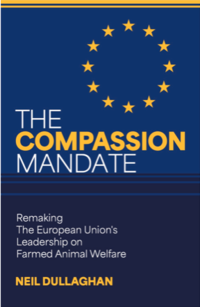
The Compassion Mandate: Remaking the European Union’s Leadership on Farmed Animal Welfare by Neil Dullaghan (Books of Change, January 2026)
According to the European Commission, 84% of EU citizens want stronger protections for farmed animals, yet progress toward meeting that demand has stalled. The book begins by reminding us that vast numbers of animals are farmed cruelly in t ightly confined industrial sheds and stalls, conveniently out of sight, across Europe, in ways that would upset most of the consumers who buy and consume the resulting meat and dairy products. The Compassion Mandate examines farmed animal welfare in the EU, detailing Europe’s long arc from animal welfare leadership to recent failures, with suggestions for reversing the trend. For decades, the European Union led the world in regulating the treatment of farmed animals. Today, the author (Mansfield, 2014) says, the EU risks losing its leadership position and betraying the strong will of its citizens, who overwhelmingly support higher animal welfare standards. The Compassion Mandate examines how EU reforms advanced, stalled, and can be remade through improved enforcement, coherent trade rules, and transparency toward consumers. Although individual EU countries have taken disjointed steps towards reform over the years, Dr Dullaghan reveals how a unified push for progress, as the EU rather than independent nations, would have an exponentially greater impact, changing the tide of reform while positioning the EU for economic gain.
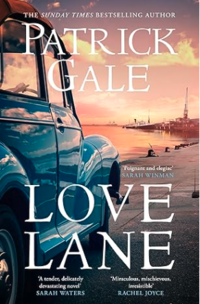
Love Lane by Patrick Gale (Tinder Press, March 2026)
The author (New College, 1980) is an Emmy-winning blockbuster author and no stranger to the Sunday Times best-seller list. He also inhabits the UK’s most westerly rose garden down in Cornwall and will later this summer throw it open to local Oxford alumni. For the current novel, he says that while it picks up on his previous A Place called Winter it is not to be understood as a sequel but rather as an ‘adjacent novel’. ‘It’s designed to stand alone and will equally excite fans of the earlier novel to find out more and newcomers to race back in time to discover Harry’s earlier story…’ The plot line has veteran Canadian wheat farmer Harry Cane sail home to an England transformed by two world wars, his arrival triggering unwelcome self-examination for the family he abandoned. His daughter feels duty bound to take him in but is ambushed by a long-buried anger she has never before expressed. Harry's effect on the next generation is less predictable, and enables his granddaughter to deal with an unspeakable trauma, while her gentle husband feels seen for who he truly is. Can Harry stay and make a new life before it's too late, or will he find himself cast out again, punished for having witnessed and understood too much?
move to carousel movement controls
 Pause slideshow
move to carousel content
Pause slideshow
move to carousel content

EBOLA: WE NEED MORE THAN A VACCINE
EBOLA: WE NEED MORE THAN A VACCINE

30 YEARS OF THE THAMES PATH
30 YEARS OF THE THAMES PATH

ANOTHER WORLD
ANOTHER WORLD

SATIRE COMES TO THE SHELDONIAN
SATIRE COMES TO THE SHELDONIAN

OFF THE SHELF: MAY 2026
OFF THE SHELF: MAY 2026
THE WONDER OF BIRDS
THE WONDER OF BIRDS

FRAN MONKS
FRAN MONKS

OXFORD ALUMNA NOMINATED FOR TURNER PRIZE
OXFORD ALUMNA NOMINATED FOR TURNER PRIZE

VALUING SILENCE
VALUING SILENCE

‘BIG BANG’ OF ANIMAL LIFE EARLIER THAN THOUGHT
‘BIG BANG’ OF ANIMAL LIFE EARLIER THAN THOUGHT

OXFORD’S WOMEN TRIUMPH IN THE BOAT RACE
OXFORD’S WOMEN TRIUMPH IN THE BOAT RACE
Pause slideshow

