


OFF THE SHELF: SEPTEMBER 2026
FRAN MONKS
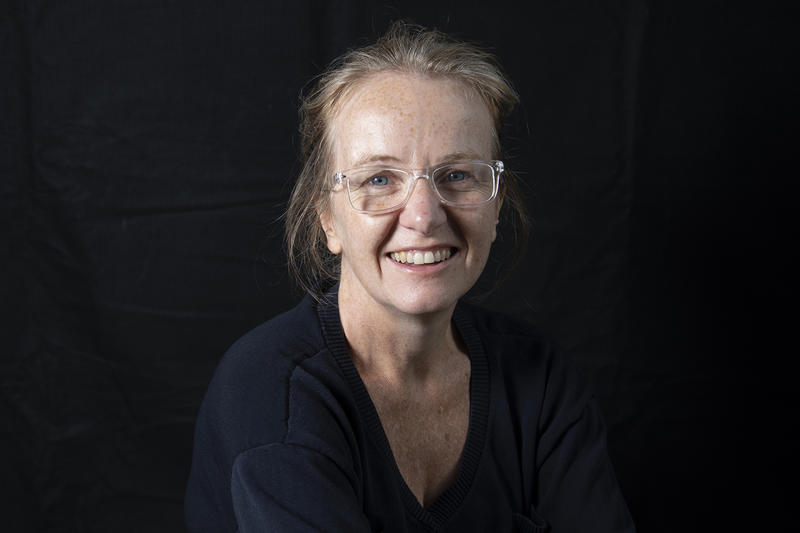
A school child in Fleetwood, the northern tip of Blackpool, Fran Monks came to Oxford in zigzag fashion, attending Leeds University to read Chinese and Japanese; living in Taibei in 1990, not long after the Tiananmen Square massacre; moving on to environmental studies at Imperial College London; working as a ‘misfit’ agent of change inside oil company Shell in Aberdeen, then in London; then off to Washington, DC with her husband; and only then later to Jericho where she lives now.
‘What I liked about America was the lack of barrier to doing something new. I studied art at the Corcoran School of the Arts and Design [in DC], then worked as a family photographer, a common thing in the US where family portraits are in constant demand; then over time developing my art as a portraitist.’
We are here to discuss five portraits that visitors encounter towards the conclusion of the 'In Bloom' exhibition that recently opened at the Ashmolean, but it quickly becomes apparent that there is a wider sweep of Oxford work that has led to this latest commission.
Keble College commissioned Fran to take portraits of college members ‘making a difference’, which led to a special hanging within the dining hall, amid rather than instead of the older oils on the walls. The college was so happy with the outcome that they did it again.
‘They now have three different generations of these photographs, 28 in each, and there is a plan to rehang all of them in the H B Allen Centre [Woodstock Road].’
All of Fran’s portraits of Oxford people have a painterly quality to them.
‘I really care a lot that pictures look as respectful as oil paintings. There is a risk with photography that it might look tokenistic.’

Working with a Canon R5 MKII, she will typically meet a subject for two hours and during the shoot take as many as 150 images. ‘We’ll have a good chat first, relax a bit. I typically ask them to wear solid colours bright or dark, long sleeves, not busy patterns. The painterly quality will be on account of real inspiration sometimes by an Old Master, but I’ll recreate it mostly through light and through setting – that’s where Oxford is amazing.’
She says that natural light is always preferable but not always possible, and that these days ‘flash’ has been replaced by all manner of softer, additional lighting technologies including the humble reflector that bounces natural light back into the subject from the side.
One of the most significant commissions Fran has received is ‘Oxford Women’, to mark the centenary of the first woman matriculating to Oxford, although the shoot was delayed until 2022 on account of COVID (shown, above right).
At the Ashmolean exhibition 'In Bloom', which opened in March and runs until 16 August, you go on an amazing, plant-led global journey that explores the little-known stories of exchange and exploration that typically lie behind garden flowers that we take for normal.
In the last room you arrive at five handsome portraits of individual post-holders at the University: Stephen Harris (Druce Curator of the Herbaria); Chris Thorogood (Deputy Director, Botanic Garden and Arboretum); JC Niala (Deputy Director, History of Science Museum); Jane Langdale (Professor of Plant Development, Department of Biology); and Yadvinder Malhi (Professor of Ecosystem Science at the Environmental Change Institute).
Fran proffers a phone screen showing Sir Joshua Reynolds’ 1771-73 portrait of botanist Sir Joshua Banks, following his triumphant return from Captain Cook’s expedition to the South Pacific. At his elbow is a globe, and Latin words on a letter that translate, ‘tomorrow we’ll sail the vast deep again’. This was her inspiration for the portrait of Yadvinder Malhi.
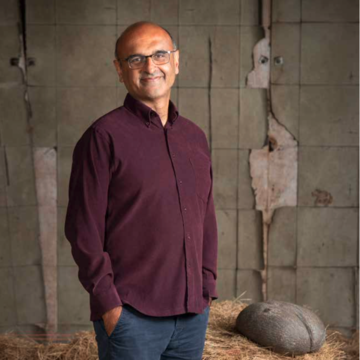
If that was about exploration, knowledge and power, Yadvinder has instead posed with a sea coconut, the largest seed in the plant kingdom, nestled on a bale of straw to his left (shown, left).
Fran comments: ‘The seed is an entity in its own right: the seed has status.’
This is different from man asserting dominion over the natural world and essentially using the painting to project power.
Yadvinder extols mystery and also myth alongside science, noting that the coco-de-mer will float for thousands of miles across the Indian Ocean from their origins on the Seychelles, yet are never viable so cannot take root when washed up on a faraway beach.
In the past, the seed inspired imaginings of seabed forests and magical kingdoms; now we conceive the biology ‘as an emblem of island endemism and ecological fragility’. Both approaches point to an enduring truth, Yadvinder suggests, that for all our conquest of the past few centuries ‘the natural world is larger and stranger than we often imagine’.
The other portraits incorporate objects ranging from a rare collection of preserved British mosses, a carnivorous pitcher plant, a seed paper and specimens of maize and rice, which Professor Langdale is working on in a global team to engineer some of the benefits of the maize into the rice.
The big themes are multi-generational care leading to real knowledge progress instead of empty headlines, and in respect of Fran’s art the fact that we are all part of nature rather than apart from nature, and fragile too rather than all-powerful as used to be assumed.
Fran says that she wild swims in Port Meadow and is in the process of engaging with Thames Water with a view to producing diptychs that might convey the invisible bond of trust that needs to exist between different parts of society, in this case a private water company and the public who depend upon the water.
Noting that she has not yet become sick from swimming in the Thames, despite numerous reports of the water being unfit, she says: ‘It is difficult in such situations to perceive risk. We trust people who are invisible to us. If the trust breaks down we’re all in deep trouble.’
move to carousel movement controls
 Pause slideshow
move to carousel content
Pause slideshow
move to carousel content
ELLA BARON
ELLA BARON
THE IMPORTANCE OF VACCINE ADVOCACY
THE IMPORTANCE OF VACCINE ADVOCACY
SILICON VALLEY CAREER TALK
SILICON VALLEY CAREER TALK

DEGREES WORTH IT AFTER ALL
DEGREES WORTH IT AFTER ALL

OFF THE SHELF: AUGUST 2026
OFF THE SHELF: AUGUST 2026
THE RISE OF BACTERIAL RESISTANCE FROM POULTRY FARMS
THE RISE OF BACTERIAL RESISTANCE FROM POULTRY FARMS
NATURAL HISTORY AT OXFORD REVAMPED
NATURAL HISTORY AT OXFORD REVAMPED
OFF THE SHELF: JULY 2026
OFF THE SHELF: JULY 2026

MALACHI MCINTOSH
MALACHI MCINTOSH
EBOLA: FIRST VACCINATION
EBOLA: FIRST VACCINATION
GRAPPLING WITH THE GHOSTS OF CARIBBEAN COLONIALISM
GRAPPLING WITH THE GHOSTS OF CARIBBEAN COLONIALISM
Pause slideshow

